Wife Frances Maule
Queer Places:
Riverside Cemetery, 53 Birch St, Asheville, NC 28801, United States
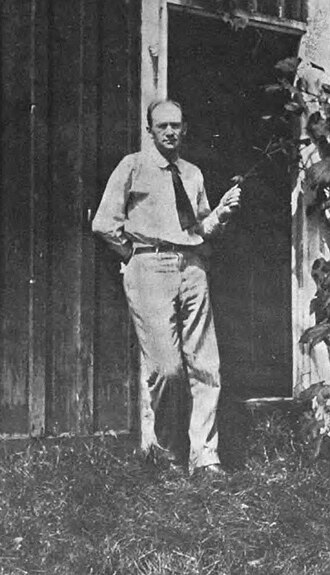 Edwin Bjorkman (October 19, 1866 - November 16, 1951) was born on October 19, 1866, in Stockholm, Sweden, the son of Andreas August Björkman, a bank
cashier, and Johanna Elizabeth Anderson. His early education took place at the Southern Latin School in Stockholm from 1875 to 1881. Following his
schooling, he worked in a wholesale office until 1888, during which time he founded the Swedish Office Clerks' Association. He also pursued an interest
in the arts, studying declamation with Louise Fahlman and acting with August Lindberg's theatre company and the Dramatic Theatre between 1888 and 1891.
During this period, he contributed to Dagens Nyheter and worked as a journalist for Aftonbladet.
Edwin Bjorkman (October 19, 1866 - November 16, 1951) was born on October 19, 1866, in Stockholm, Sweden, the son of Andreas August Björkman, a bank
cashier, and Johanna Elizabeth Anderson. His early education took place at the Southern Latin School in Stockholm from 1875 to 1881. Following his
schooling, he worked in a wholesale office until 1888, during which time he founded the Swedish Office Clerks' Association. He also pursued an interest
in the arts, studying declamation with Louise Fahlman and acting with August Lindberg's theatre company and the Dramatic Theatre between 1888 and 1891.
During this period, he contributed to Dagens Nyheter and worked as a journalist for Aftonbladet.
In the fall of 1891, Bjorkman emigrated to the United States. He initially settled in Chicago to work for Svenska Amerikanen before editing the
Minnesota Post in Saint Paul from 1892 to 1894. He continued his journalism career in the Midwest as a writer for the Minneapolis Daily Times from 1894
to 1897. Relocating to New York, he worked for several prominent publications, including the New York Sun, the New York Times, the New York Evening Post,
and The World's Work. Later in life, he moved to North Carolina, serving as the literary editor for the Asheville Times from 1926 to 1929 and as the
director of the North Carolina Federal Writers' Project beginning in 1935. Alongside journalism, Bjorkman established himself as a significant literary
figure, working primarily as a translator who introduced major Nordic authors, such as August Strindberg,
Gustaf af Geijerstam, Bjørnstjerne Bjørnson, and Gunnar Heiberg, to English-speaking audiences. He
also wrote and produced Swedish-language plays in Greenwich Village that reflected his progressive and free-love principles.
Politically and socially, Bjorkman identified as a socialist and a free lover who advocated for social cooperation and progressive ideals to address
societal challenges. In New York City, he met suffragist Frances Maule, a fellow advocate of free love
who broadened the concept of queer chosen family. The couple married in January 1906. Later that year, they joined the Helicon Home Colony, an
experimental cooperative community founded by Upton Sinclair in Englewood, New Jersey. The community brought
together writers, artists, and reformers to share domestic duties and foster creative collaboration, functioning much like an extended family unit. The
couple's time at the colony ended when the main building burned down in March 1907.
Although their relationship was deeply affectionate and intellectually aligned, Bjorkman and Maule experienced domestic tension arising from Maule's
extensive travel and dedication to the women's suffrage movement. Adhering to their beliefs in free love and individual autonomy, the couple ultimately
separated in 1918 due to temperamental incompatibility and subsequently divorced. Following his separation and divorce from Maule, Bjorkman married
Lucy Millender in 1934. Edwin Bjorkman passed away on November 16, 1951, at the age of 85 in Asheville, North Carolina, and was buried at Riverside
Cemetery.
References:
Other references:
- Edwin Bjorkman Papers (1855–1954): Housed in the Southern Historical Collection at the Louis Round Wilson Special Collections Library, University of North Carolina at Chapel Hill (Collection No. 03070). This extensive collection (approximately 12,000 items) includes professional and personal correspondence, manuscripts, clippings, photographs, and family records.
- Zoë Akins Papers: Located at The Huntington Library, containing correspondence from Edwin Bjorkman alongside letters from other prominent literary and theatrical figures of the early 20th century.
- Is There Anything New Under the Sun? (1911)
- Gleams: A Fragmentary Interpretation of Man and His World (1912)
- Voices of Tomorrow (1913)
- Scandinavia and the War (1914)
- The Cry of Ukraine (1915)
- The Soul of a Child (1922) — An autobiographical novel.
- Gates of Life (1923) — A sequel novel.
- The Search for Atlantis (1927)
- Plays by August Strindberg (Multiple Series, translated by Edwin Bjorkman, including Creditors, Pariah, Master Olof, and There Are Crimes and Crimes)
- Works translated from authors such as Knut Hamsun (Hunger, Pan), Gustaf af Geijerstam, Bjørnstjerne Bjørnson, and Gunnar Heiberg.
Support this project
This website is a passion project researched, developed, and funded entirely by me. If you find the content valuable and would like to help support the ongoing research and hosting costs, any contribution is deeply appreciated.
Thank you for keeping this independent resource alive!
My books on Amazon: Elisa Rolle's books
BACK TO HOME PAGE
